
Mapping the World
Each person who ever lived contained within themselves an entire lifetime of sensations and experiences. From these, there is a functionally infinite dataset from which to draw history. Of course, most of what happened hasn’t been recorded in any way for a contemporary observer to review. And even if it had been, there would be no possible way for a single mind to interpret that staggering quantity of information. Moreover, even if one could interpret it, vast swaths of it would simply be repetitive or uninteresting. In fact, even in my own unitary lifetime, the overwhelming majority of what I do is just as quickly forgotten. So how are we to reconcile this preponderance of information with our own finite capacities?
This dilemma reminds me of the parable of the king who, unsatisfied with a mere pocket map of his kingdom, orders his cartographer to scale it up so that the map is exactly as large as his kingdom. Of course a map the size of that which is being mapped would be utterly useless, just as a set of data describing every moment of every life would fail to provide any meaningful comprehendible information. It is indeed the synthesis of information that makes a map useful, and likewise for any other framework interpreting a ceaseless quantity data.
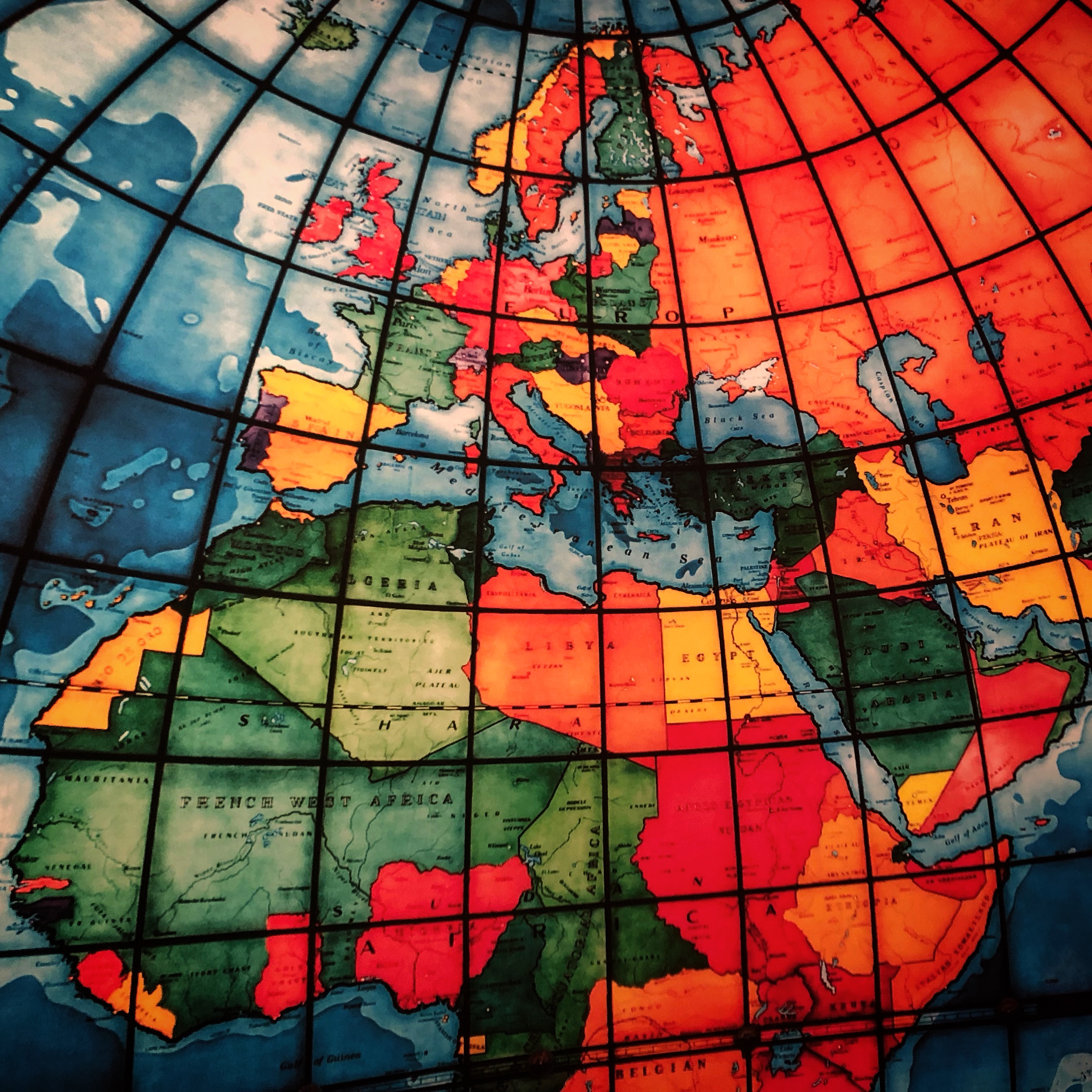
However, the moment we begin to synthesize, we have also begun to decide which details are relevant and which are expendable. So the natural question to follow is: for what purpose is the map being made? A national roadmap of the US will differ wildly from a subway map of NYC. While the latter is encompassed within the same physical area as the former, the two will bear virtually no resemblance to each other in either scale or detail. And not only does a cartographer choose what to show but also how to show it. Flip between the traffic and transit views on Google Maps and you will see mostly similar features, emphasized differently to suit their intended purpose.
Yet as with any interpretation, cartographic decisions are also capable of reproducing biases that detract from the map’s utility. The widely recognized Mercator Projection has long been criticized for exaggerating the landmass of the global north while comparatively diminishing landmasses closer to the equator. For instance, it gives the impression that Greenland is roughly equivalent in size to Africa, a landmass 14 times its area. And speaking of continents, we have long pretended that Europe is indeed one, separated from the rest of Eurasian landmass by the Ural Mountains, while the Indian subcontinent sitting across the mighty Himalayas gets no such distinction. To be sure, “cultural” differences that historically justified the continental definition also reek of orientalism, as the South Asian landmass contains no fewer languages and ethnicities than does Europe.
So in order for the human mind to interpret reality, an immeasurable amount of information must be synthesized into simple models or frameworks. And in synthesizing this information, intentional decisions must be made to determine what should be excluded and how best to represent what is included. But whether you are developing a model based on your direct observations or simply building off the output of someone else’s, both your sources and interpretation may reproduce biases, either intentional or unintentional. So how do we reconcile the impossibly vast amount of information in the world with our finite and fallable capacity to understand and interpret it?
Thinking for Yourself
There is paradox inherent to the idea of “thinking for yourself”. All thinking requires the intake of external information, much of which has already been synthesized by others. So “thinking for yourself” is always situated at the intersection of your curation of external sources and your internal intuitions, values, heuristics, and analyses—which are themselves informed by prior external sources.
If you are too “independent” in your thought you will likely suffer from lack of expertise. By including only information that is directly perceived and excluding information that has been mediated through some external source, your ability to understand information outside your immediate realm of knowledge will be severely limited. Lacking the basis to develop thought beyond your own observations will typically result in confirming your own prior beliefs. And if you are too “dependent” in your thought, then you are simply outsourcing your critical capacities to others, and likely selecting those sources based again on your own confirmation bias. In either case, we are susceptible to simply reproducing our existing beliefs both by the sources we’ve come to trust and by our ability to interpret them.
So how then can we develop knowledge without simply regurgitating your own prior thought ad infinitum? There must be a dialectical relationship between your intake of information and your processing thereof. One’s personal knowledge can only grow when supplied with reliable expertise, but one can only ascertain the reliability of that expertise through their personal knowledge. This knowledge then must be tested against experience and reality, often in terms of its explanatory power and the plausibility of the mechanisms that causally connect those explanations to their consequences. Ultimately, one should arrive at a systematic understanding of the subject with some degree of predictive power. In as far as the system fails to predict, it must be revised accordingly.
Sculpting Frameworks
To escape the circular dilemma between intake and interpretation we must be humble in our reflexive impression of the world, yet confident in our ability to intentionally learn. Through honest introspection we can admit when our mental models are stale and rejigger them as necessary to describe the world as it exists. A stale model might be something we passively absorbed in a childhood classroom or from watching a fictional movie. Do you really know how the criminal justice system works? Or do you have the vague impressions left by untold hours of Law & Order reruns? Do you really know what life is like in that country you’ve never been to? Or has its populace been dehumanized in action flicks to drum up support for a war against them? Do you really know that crime is “skyrocketing”, or has that talking point been broadcast by news media selling ads and politicians selling fear? Wherever our information comes from, fictional or otherwise, its source may quickly recede into oblivion—while its imprint remains, calcified into immutable fact by the sheer force of the time it has sit in our heads. These imprints are the well-worn grooves repeated by state and media alike, that give permission to forgo critical thinking in favor of the familiar refrains we’ve come to passively absorb. New information is often shoehorned into its nearest groove, or if too antithetical to existing clichés, simply ignored altogher. But each day we are expected to draw upon some font of knowledge beyond our familiar domain, and these narratives are the comfortable slippers that allow us to curl up with our most base, caricatured understanding of the world.
Still, with humility, we can begin to recognize when we are attempting to draw water from a poisoned well. In many matters it is perfectly appropriate to simply admit ignorance rather than parrot misinformation and lazy narratives. But we must also refrain form fatalistically resigning ourselves to a hopeless epistomelogical quandary. The world is indeed knowable and anybody can learn anything they are curious about. Indeed, it is incumbent upon anyone who seeks to improve the world to be diligent in understanding it. And to do so requires we can evaluate the trustworthiness of the source with few simple questions that can help shape our interpretation of their content. The following are some heuristics I find useful:
• What basis for their knowledge do they possess? Is it a first hand account? Is it a subject that they have studied extensively? Has the source withstood good faith scrutiny?
• What interest do they have in sharing it with you? Do they benefit from deceiving you? Or are their incentives aligned with yours? Note that an honest source will be upfront about their incentives and philosophical perspective while a dishonest source will disguise their argument in a veneer of neutrality or objectivity.
• Is it logically consistent? Does the explanation rely on a sequence of irrational leaps of faith and the esoteric foibles of individual actors? Or do their actions follow clearly from their incentives and align with structural factors?
• How well does the source represent alternate perspectives on the issue? Do they understand the counter-arguments and address them in good faith? Or do they cherrypick the worst arguments and dunk on those?
If the information presented can satisfy these criteria, then you might ask: how does it update my existing mental framework? Does it strengthen it by validating my prior predictions? Does it weaken it by providing a counter example? In the latter case, it is prudent to revise your theory to either incorporate the contexts in which exceptions might occur or reevaluate your premise altogether.
Building a mental framework is not unlike both additive and subtractive sculpting. From the information available, you must first build up a hypothesis in clay. Then against scrutiny, you must chisel it like stone. The sculpture becomes larger as your basis of knowledge grows, and it gains definition and resilience as it is subjected to good faith critique. Over time, it becomes easier to recognize reliable sources while identifying misinformation, and it becomes easier to recognize valid criticism while identifying sophistic or deceptive attacks.
Setting Sail
Robust mental frameworks are the maps that allow us to navigate the unbounded sea of data. And where a faulty map will send you off course, adrift in the doldrums of state propaganda and conspiracy theories, a proper map is the tool required to see through the morass and effect meaningful systemic change in the world. The specific framework you need—that is, the specific features that the map should highlight—will depend on your objective. Some details may be crucial to one objective and irrelevant to another.
And while these maps can only exist in the minds of each individual, their composition is a social, collaborative process where we build on the expertise of others, present and past, and challenge each other to further refine our understanding. There is much that as a civilization we must work to change, but to do so we must neither stumble through the dark of ignorance nor drown in the depths of detail. Rather, everyone who chooses to learn and approaches the process in good faith can become their own cartographer and together, develop the theory required for successful practice in their respective spheres.
 Transpophile